What it does
Add variation that reaches through the terrain, rather than repeating down each column. This lets the ground fold into overhangs or contain tunnels. Octaves are layers of progressively finer noise.
Start by adding a little of Output to existing terrain through Scale and Sum. Adjust Scale Y relative to Scale X and Scale Z to make the shapes flatter or taller. Persistence controls the strength of finer layers; Lacunarity controls how quickly they shrink.
In 3D
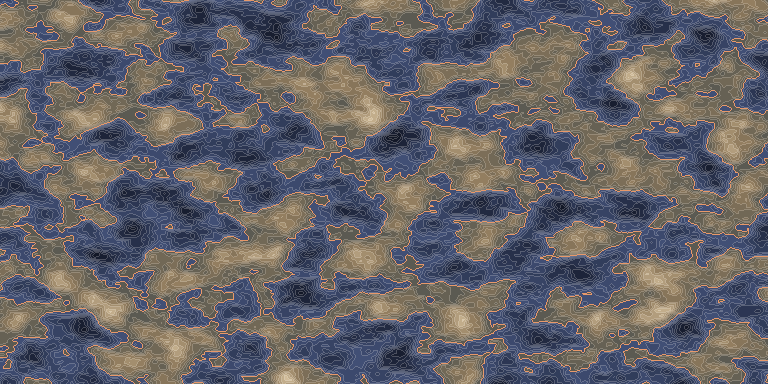
The noise shaping real terrain: added to a slope from solid ground to open sky, it carves overhangs, caves and floating pieces.
Inputs and outputs
| Name | Type | Default | What it changes |
|---|---|---|---|
| Inputs | |||
| Seed | Integer | 1 | Changes the noise pattern throughout the volume. |
| Scale X | Real | 64.0 · > 0 | Higher values stretch the shapes along X. |
| Scale Y | Real | 64.0 · > 0 | Higher values stretch the shapes vertically. |
| Scale Z | Real | 64.0 · > 0 | Higher values stretch the shapes along Z. |
| Octaves | Integer | 3 · 1–64 | Adds finer layers of detail throughout the volume. |
| Persistence | Real | 0.5 · ≥ 0 | Higher values strengthen the finer layers. At zero, only the first layer shows. |
| Lacunarity | Real | 2.0 · > 0 | Higher values make each new layer smaller more quickly. At 1 the layers all keep the same size, and below 1 they grow instead. |
| Output | |||
| Output | Density | Smooth noise that varies horizontally and vertically. | |
Good to know
Carve along the zero crossings
Pass the noise through Absolute Value, then lower it with Offset. Take the minimum with terrain to open tunnels where the result is negative.