On noise
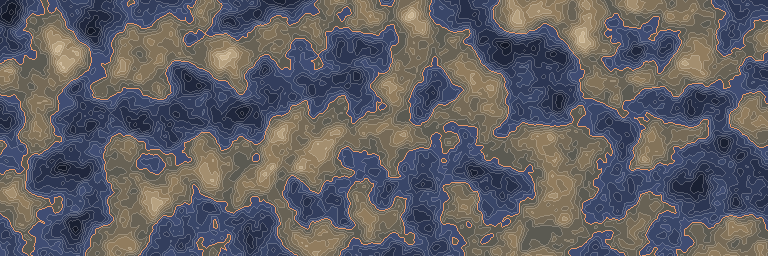
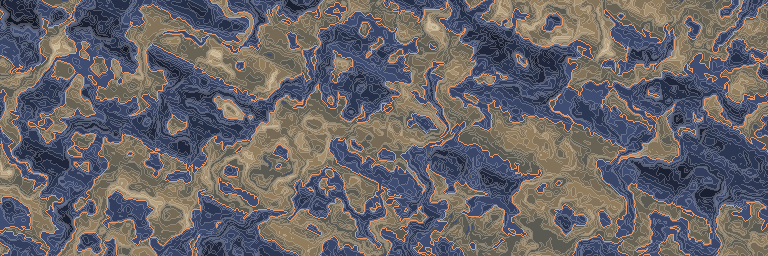
The same noise before and after this node, seen from above.
In 3D
The same output in relief: each value becomes a height, coloured like the map above. Drag to look around.
Inputs and outputs
| Name | Type | Default | What it changes |
|---|---|---|---|
| Inputs | |||
| Input | Density | ||
| Warp | Density | ||
| Factor | Scalar field | 8.0 | |
| Direction X | Scalar field | 1.0 | |
| Direction Y | Scalar field | 0.0 | |
| Direction Z | Scalar field | 0.0 | |
| Output | |||
| Output | Density | ||
Good to know
How it works
The warp input controls displacement. Factor and each XYZ direction component accept a literal, value graph, or density field sampled at that coordinate.
Useful for
Bending strata, stretching cave fields, and adding coherent lean to a shape. Use broad, smooth warp fields for readable forms.
Watch for
The direction is normalized per sample. A literal zero direction is invalid; a sampled zero direction safely means no displacement. High-frequency fields can fold shapes into noisy fragments.